
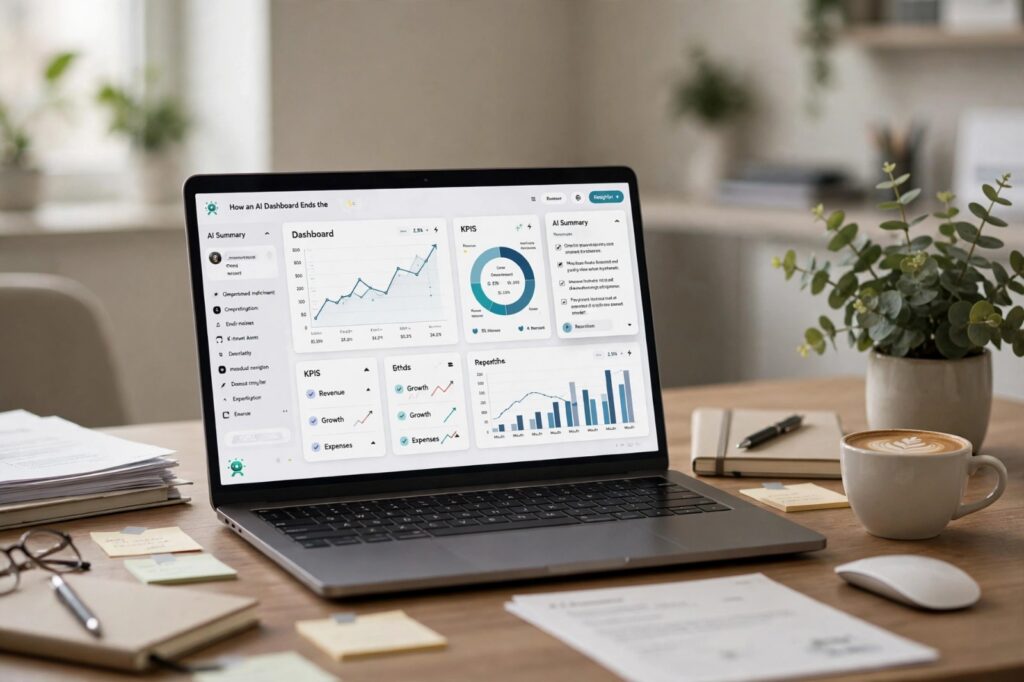
Automated business reporting uses AI to pull numbers from a company’s systems and write weekly and monthly summaries without anyone building a spreadsheet. The owner gets a clear report on time, every time. MagCo sets up automated AI reporting inside its AIOS dashboards for NZ and Australian SMEs.
What does the reporting scramble cost a business?
In many SMEs, reporting looks like this. Someone exports data from the CRM. Someone else pulls numbers from Xero. A spreadsheet gets updated, usually late, often with errors. The owner gets a report a week after the month ends, by which time the information is stale.
The direct cost is staff time, often a full day or more each month. The bigger cost is slow decisions. When an owner only sees the numbers weeks later, problems have already grown and opportunities have already passed.
How does automated AI reporting work?
Automated reporting has three layers.
- Connection. The dashboard connects directly to the CRM, accounting software, ad platforms and job tools. Data flows in on its own.
- Calculation. The key numbers are calculated automatically, the same way every time, so there is one version of the truth.
- Interpretation. An AI layer reads the numbers and writes a summary in plain English, highlighting what changed, what is off track and what needs a decision.
The result is a report that arrives on schedule, in the owner’s inbox or on their phone, without anyone touching a spreadsheet.
What does an AI-written business summary look like?
A good AI summary is short. It leads with what matters. For example:
“Revenue for October is 6 percent ahead of target. Quote conversion dropped from 41 percent to 33 percent, mostly on jobs over $10,000. Three large quotes have had no follow-up in more than seven days. Cash is healthy, with $48,000 due in the next fortnight.”
Four sentences. Every one of them points to an action. That is the standard MagCo builds to. The summary should save the owner time, not hand them more reading.
Which reports should be automated first?
Start with the reports that happen most often and take the most effort. In most SMEs, that means:
- A weekly sales and pipeline summary for the owner and sales team
- A monthly performance report against targets
- A marketing report showing cost per enquiry by channel
- A board or leadership pack, if the business has one
Once these run reliably, other reports can follow. MagCo usually builds the weekly summary first, because it creates a habit and proves the system works.
Does automated reporting replace an accountant or analyst?
No. It replaces the manual work of gathering and formatting numbers. Accountants still handle compliance, tax and financial advice. Analysts, where a business has them, spend less time building reports and more time acting on them.
For most SMEs in the $2m to $10m range, automated reporting removes the need to hire someone purely to produce reports. That is often where the return on investment shows up first.
Frequently asked questions
1. How accurate are AI-written reports?
The numbers come straight from the source systems, so they are as accurate as the underlying data. The AI layer only interprets those numbers. MagCo checks summaries against the raw data during setup to confirm they read correctly.
2. Can reports be customised for different people?
Yes. The owner, sales lead and operations manager can each receive a version focused on the numbers they own.
3. What if our data is messy?
That is common. MagCo cleans up the key data sources during setup, because a report is only as useful as the data behind it.
Related reading
- What Is an AI Operating System (AIOS) for a Business?
- AI Business Dashboard NZ: What It Should Show and Why
- AI Automation for Small Business in NZ: Where to Start
If month-end reporting still takes a day of someone’s time, book a free AI audit. MagCo will show you what can be automated first. Book a free AI audit